"GravyDay", "Paul Kelly" and "the 21st of December" were trending terms on Twitter, with many posts playing off How To Make Gravy's narrative.
Joe, the song's made-up protagonist, sings about his family's traditions, such as relatives "driving down from Queensland" and "flying in from the coast".
The song has even been likened to "an Australian Christmas carol". Instead of northern-hemisphere references to cold things, Joe anticipates a hot Christmas Day.
"They say it's gonna be a hundred degrees, even more maybe," the lyrics read, "but that won't stop the roast".
His emotional messages to family - such as "give my love to Angus and Frank and Dolly" - have become a particular focus of fun.
And just what is the best gravy recipe? According to the lyrics, it is: "Just add flour, salt, a little red wine, and don't forget a dollop of tomato sauce, for sweetness and that extra tang."
Some said they would follow that advice, but others questioned the recipe.
The mobile unit of Japanese tech giant Softbank has had a disappointing debut on the Tokyo stock market.
The firm raised as much as 2.6 trillion yen ($23bn; £18bn) by selling shares at 1,500 yen each in one of the world's largest ever stock offerings.
But as markets opened in Tokyo on Wednesday, shares were trading down at 1,463 yen.
Originally a telecoms firm, Softbank has become a vast conglomerate covering robotics, chips and investments.
The firm was founded by Japan's richest man Masayoshi Son.
By the close of morning trade on Wednesday, Softbank Corp's shares were down 10.6%.
What does this sale mean for Softbank?
While you could already buy shares in Softbank itself, its telecommunications unit, called Softbank Corp, is now also available for public purchase.
The firm's initial public offering (IPO) - a way for a company to raise new capital - was seen as cementing Softbanks' move from a domestic telecommunication provider to a global tech investor.
It was expected to be one of the biggest-ever offerings of shares on any stock market.
Chinese ecommerce giant Alibaba IPOed for a record $25bn in 2014. In comparison, Facebook only raised $16bn when it went public in 2012.
The disappointing trading debut was expected by some analysts.
But David Kuo, a market analyst in Singapore, told the BBC that the stock price should pick up once investors understand better how to value Softbank's telecoms arm.
"As an entrepreneur, Masayoshi Son had the freedom to invest as he wished," Mr Kuo said.
"But the [newly listed arm] now has to play by the harsh rules of the market. It will be valued on revenues, profit and cash flow."
What is Softbank?
Softbank started as a telecoms company but has spread out through many deals and investments.
The firm has moved into robotics, bought UK chip firm ARM Holdings and invested in satellite start-up OneWeb and ride-sharing firms, as well as in self-driving technology with Toyota.
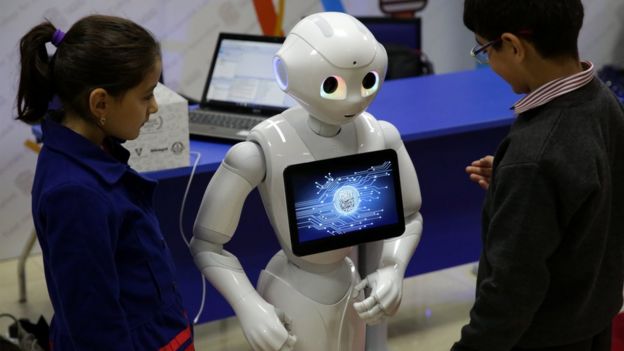
Image copyrightEPAImage captionSoftbank is behind the robot Pepper
It also acquired Vodafone's Japanese operations and the US telecoms company Sprint.
The firm set up a venture fund with Saudi Arabia, which focuses on emerging technology and has around $90bn at its disposal.
Saudia Arabia is the fund's major investor and other backers include Apple and Foxconn.
But Softbank has come under criticism for co-operation in light of the recent death of Saudi dissident journalist Jamal Khashoggi.
Mr Son founded Softbank and has guided it to become one of the world's biggest technology companies.
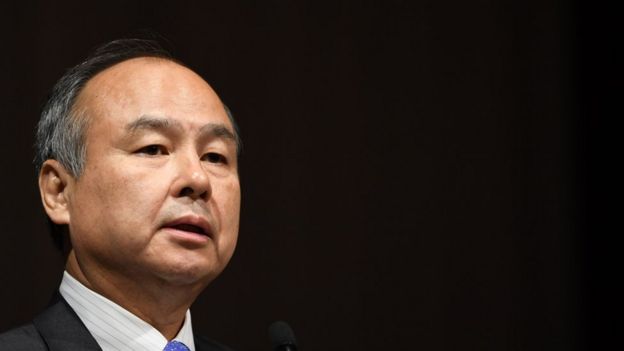
Image copyrightGETTY IMAGESImage captionMasayoshi Son is Japan's richest man, according to Forbes
The entrepreneur - Japan's richest man according to Forbes Magazine - is known for having an eye for firms with big potential and for spotting transformative industries and trends.
He saw the potential in e-commerce before many others and was an early investor in Alibaba.
Often described as the Steve Jobs or Bill Gates of the Japanese business world, he's seen as someone quite different from country's more conservative corporate culture.
Google has reportedly "effectively ended" plans for a censored search engine in China.
The Intercept, which revealed the existence of Project Dragonfly in August, says Google has been "forced to shut down a data analysis system it was using" to feed the project.
And access to data "integral to Dragonfly... has been suspended for now, which has stopped progress".
Google said it had no immediate plans to launch a Chinese search engine.
Image copyrightGETTY IMAGESImage captionGoogle has faced protests about the search engine it was working on for China
What is The Intercept reporting?
Citing internal Google documents and inside sources, the Intercept says Project Dragonfly began in the spring of 2017 and accelerated in December after Google's chief executive, Sundar Pichai, met a Chinese government official,
An Android app with versions called Maotai and Longfei were developed and could be launched within nine months if Chinese government approved, it says.
Using a tool called BeaconTower to check if users' search queries on Beijing-based website 265.com would fall foul of China's censors, Google engineers came up with a list of thousands of banned websites, including the BBC and Wikipedia, which could then be purged from the Dragonfly search engine.
But members of Google's privacy team confronted the Dragonfly project managers, saying the system had "been kept secret from them".
And after several discussions, "Google engineers were told that they were no longer permitted to continue using the 265.com data to help develop Dragonfly, which has since had severe consequences for the project".
Image copyrightREUTERSImage captionGoogle's Project Dragonfly is reportedly on hold in China
What are the issues with launching a search engine in China?
The so-called great firewall of China is notorious for not allowing its citizens free access to all the content available on the internet.
China has in the past two years imposed increasingly strict rules on foreign companies, including new censorship restrictions.
Some Western sites are blocked outright, including Facebook, Twitter and Instagram.
Certain topics such as the Tiananmen Square protests in 1989 are also completely blocked.
References to political opposition, dissidents and anti-Communist activity are also banned as are those to free speech and sex.
Any search engine in China would have to comply with the Chinese government's strict rules on censorship.
Analysis
by Dave Lee, BBC North America technology reporter
Even with this news today, I don't think Google's ambitions in China are over - just stalled.
Sundar Pichai has clearly decided that China is too important (and lucrative) a market to pass up and so, while Dragonfly has met a significant bump in the road - thanks to its own privacy team, the company will almost certainly find a new approach to serving the Chinese market.
But in doing so it might do serious harm to its brand.
Now more than ever, US technology companies are under pressure to act in the interests of both America and Americans.
Bowing to Beijing's demands with whatever Project Dragonfly morphs into will be a stain on Google's principles and its reputation.
How advanced were the plans?
We learned from Mr Pichai's recent appearance on Capitol Hill that more than 100 engineers had been working on the project at one point in time.
When quizzed by lawmakers on the plans, he said: "Right now, we have no plans to launch in China."
He said all efforts were "internal" and did not currently involve discussions with the Chinese government.
In response to further questions, Mr Pichai said the company would be "fully transparent" with politicians if it released a search service in China.
The BBC understands Project Dragonfly never reached the point of having a full and final privacy review by Google.
A letter from more than 300 Google employees in November, co-signed by Amnesty International, asked the company to halt the project entirely.
Image captionGoogle's Project Dragonfly is reportedly on hold in China
Why does Google want to get back into China?
Quite simply, China is the biggest internet market in the world.
Google launched a search engine in the authoritarian state in 2006, google.cn.
Google was compliant with the Chinese government's censorship requirements at the time but the search company pulled the plug in 2010, citing increasing concerns about cyber-attacks on activists.
Despite its main search engine and YouTube video platform being blocked, Google still has more than 700 employees and three offices in China and has been developing alternative projects.
Its Google Translate app for smartphones was approved in China last year.
It also invested in Chinese live-stream game platform Chushou in January and has launched an artificial intelligence game on the social media app WeChat.
Hackers have taken control of printers around the world.
It is the latest in a series of such attacks, but this time they say they have the power to destroy the machines.
The stunt was first carried out last month, when one member claimed to have forced about 50,000 printers to create posters supporting his favourite vlogger PewDiePie.
The latest incident again urges support for the YouTuber, but also calls on victims to improve their security.
"I've been trying to show that 'hacking' isn't a game or toy, it can have serious real-life consequences," the original hacker told the BBC, speaking anonymously online.
"We really want people to pay attention to this because causing physical damage is very much a possibility."
He explained that flaws in the printers' firmware meant that he could continuously force data to be written to their chips.
"These chips have a limited lifetime of 'writes'," he explained.
"If you keep the loop on enough, the chip will fry and the printer will no longer function."
Hijacked files
The potential financial costs to this are obvious but the hacker also pointed to another danger that his stunt has thrown up.
"The fallout goes beyond print-outs, we could also capturing sensitive documents as they get printed or even modify documents as they get printed."
Although the hacker can geo-locate the countries that he is affecting, it's not clear whether or not a targeted attack on an individual company or household is possible.
The hackers claim to have printed out their latest message on more than 100,000 machines.
The BBC has not been able to verify the claim, but people from countries including the US, Argentina, Spain, Australia and Chile have posted pictures on social media of the latest print-outs.
More people are expected to notice their printers have created copies of the poster when they return to work on Monday.
It reads: "PewDiePie is in trouble and he needs your help to defeat T-Series!"
The message then instructs readers to subscribe the YouTuber before adding: "Seriously. Fix your printer. It can be abused!"
PewDiePie has been YouTube's most subscribed to creator since 2013. He currently has about 77 million followers on the platform.
Over recent months, the Indian music label and movie studio T-Series has come close to overtaking his lead, which has led some PewDiePie fans to mount stunts to attract new subscribers.
Image copyrightGETTY IMAGESImage captionFelix Kjellberg - who is known as PewDiePie -is currently YouTube's most subscribed to creator
'Act now'
Security vendors say that the stunt shows just how vulnerable some organisations can be to attack through the plethora of connected devices that fill modern office spaces.
Their advice is to:
carry out regular audits of connected devices
install the latest security patches
question whether or not everything connected to the internet really needs to be
"The risk of causing financial damage in this case is as real as it gets," commented Bob Reny from the security firm ForeScout.
"And all of this because organisations or individuals installed a connected device without really taking the time to audit the implications this has on their existing network security infrastructure."
The hackers provided contact details on the latest print-outs as a way to allow people to get in touch if they needed further help fix the exploited flaw.
One told the BBC that they believed they were breaking the law, but still thought their act was justified.
"While authorities might not see eye to eye with us, what we're doing is much better than someone destroying printers and offices around the world in an attempt to hold printers ransom or something."
Vulnerabilities in network printers have been known about for years but many people are unaware of the risks.
One security researcher who has studied the problem confirmed it was possible to destroy the machines by sending them commands from afar.
"These devices should never be directly reachable over the internet," said Jens Mueller from Ruhr-University in Germany.
"Who is to blame? [In offices] definitely the network administrators allowing direct access to their devices over the internet."